
Beyond the Witness Stand: 5 Surprising Ways India’s New Laws Finally Center the Victim
The Forgotten Party in the Courtroom
CRIMINAL LAW
Beyond the Witness Stand: 5 Surprising Ways India’s New Laws Finally Center the Victim
Introduction: The Forgotten Party in the Courtroom
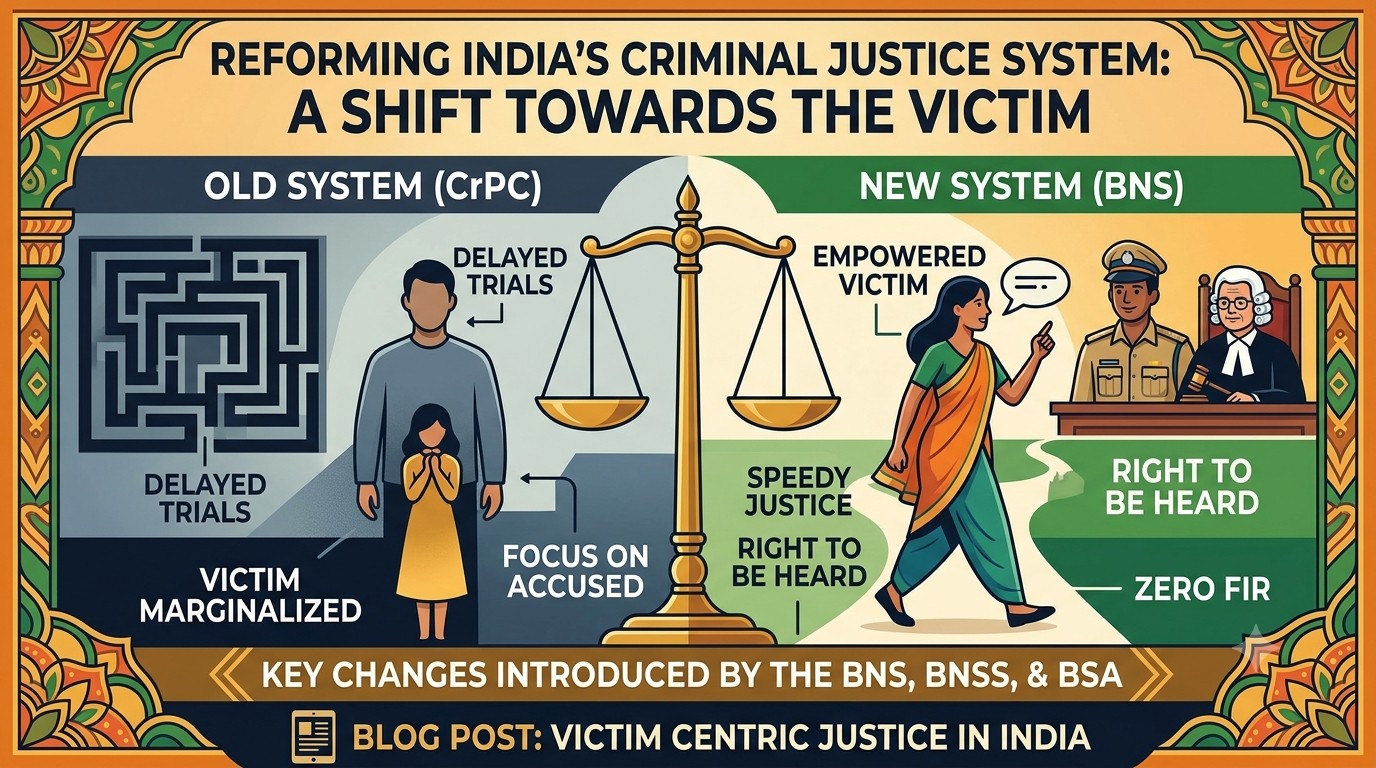
For over 150 years, the Indian criminal justice system operated as a colonial relic, fundamentally "accused-centric." In this tradition, crime was viewed primarily as an abstract offense against the authority of the State, rather than a visceral injury to a human being. This state-centric monopoly relegated the actual victim to a mere "instrumental" role—a secondary witness used to secure a conviction, only to be discarded once the gavel fell. These "invisible stakeholders" faced systematic marginalization, their plight, security, and rehabilitation left to the periphery of judicial administration.The enactment of the Bharatiya Nagarik Suraksha Sanhita (BNSS), the Bharatiya Nyaya Sanhita (BNS), and the Bharatiya Sakshya Adhiniyam (2023) marks a seismic philosophical transition. We are finally moving away from a purely retributive model toward a restorative, victim-centric paradigm. This shift aligns India with the 1985 UN Declaration of Basic Principles of Justice for Victims of Crime , which demands that victims be treated as rights-bearing individuals entitled to access justice, restitution, and dignity. As the Supreme Court articulated in Nirmal Singh Kahlon v. State of Punjab , a fair investigation is no longer the exclusive preserve of the accused; it is a constitutional mandate under Article 21 that belongs to the victim as well.
1. From Passive Observer to Rights-Bearing Stakeholder
Historically, victims were passive onlookers with zero influence over bail, charges, or sentencing. The new framework, specifically Section 2(y) of the BNSS, shatters this exclusion by expanding the legal definition of a "victim" to include dependents. This acknowledges that criminal harm ripples through families, causing both direct and indirect injury.This is not merely a change in nomenclature; it is an assertion of agency. By grounding these reforms in the "substantive equality" of Articles 14 and 15, the law now provides for practical protections like in-camera trials and anonymity for vulnerable victims. This transforms the victim from a piece of evidence into a "rights-bearing stakeholder who is entitled to fairness, inclusion, protection, and restoration."
2. The 90-Day "Right to Know" Mandate
Perhaps the most surprising shift—and a direct assault on colonial-era secrecy—is the new transparency requirement under Section 193(3)(ii) of the BNSS. For a century and a half, the police had no legal obligation to tell a victim if their predator had even been caught. Now, investigative agencies are legally mandated to inform victims of the progress of their case within 90 days. Crucially, this is not a vague update; it includes specific notification regarding the registration of the FIR and developments such as the arrest, bail, or release of the accused . By codifying this "right to know," the law ensures victims can seek timely counsel and prepare for their own safety rather than being kept in the dark by a bureaucratic machine.
3. A Mandatory Seat at the Bail Hearing
Institutional insensitivity has long inflicted "secondary victimization" on those seeking justice. Section 483(2) of the BNSS represents a major stride in protecting victim dignity by mandating the victim's presence at bail hearings for serious sexual offenses (specifically under Sections 65 and 70(2) of the BNS).This mandate ensures that the court hears the victim's perspective on their safety before making decisions that could return an offender to their community. It echoes the judicial philosophy in Bodhisattwa Gautam v. Subhra Chakraborty , which recognized that for victims of sexual violence, judicial relief is an inseparable part of the constitutional right to life and dignity. It is a necessary check on the State's previous monopoly over these critical proceedings.
4. The End of "Sham" Recognition (The Right to Appeal)
In Mallikarjun Kodagali v. State of Karnataka , the Supreme Court warned that without the power to challenge a verdict, the statutory recognition of a victim is a "sham." The BNSS codifies the victim’s right to appeal acquittals, ensuring that prosecutorial discretion does not monopolize judicial review.However, as a legal strategist, one must note the boundary of this power: under Section 413 of the BNSS, while victims have an independent interest in the result, they cannot maintain an appeal solely on the ground of an inadequate sentence . This creates a constitutional balance, allowing victims to contest the failure of justice (acquittal) while preventing the trial from devolving into a tool for pure vengeance.
5. Putting a Clock on Compensation
Under the 1973 Code, compensation was often a symbolic, delayed gesture that arrived long after the victim’s life had been upended. Section 396 of the BNSS seeks to remedy this by introducing a rigid administrative clock.The law now requires the Legal Services Authority to estimate the compensation amount within a strict two-month window. This is a direct response to the reality that "delayed compensation is a denial of justice," particularly in cases of bodily injury or loss of livelihood. While this doesn't guarantee the money is in hand in 60 days, it forces the administrative machinery to resolve the bottleneck of "estimation" that previously left victims in financial limbo for years.
The Reality Check: Bridging the Gap Between Theory and Practice
While these normative shifts are historic, they face massive "structural and institutional constraints." Without a change in the culture of the Indian police and judiciary, these rights risk remaining "symbolic" or existing only "on paper." To move from theory to lived justice, we must prioritize:
Legal Literacy: Aggressive outreach to ensure the rural and marginalized understand their new rights to information and participation.
Police Accountability: Moving away from the offender-centered paradigm and adopting performance measures that reward procedural transparency and sensitivity.
Support Infrastructure: Creating specialized victim support units within stations to provide the psychological and legal scaffolding necessary for a victim to actually exercise their rights.
Conclusion: A Humane Path Forward
The transition from a colonial, state-centric tradition to a system that honors the voice of the vulnerable is a triumph for Indian jurisprudence. By treating victims as active participants, we are finally acknowledging the lived realities of those the law is meant to protect. Yet, we must ask: Can "paper rights" truly transform a culture of institutional apathy? The ultimate effectiveness of the BNSS, BNS, and BSA will not be measured by the eloquence of their sections, but by how the system treats the "least privileged against whom crime is most likely to befall." Only when the most vulnerable feel the weight of these protections will we have truly achieved a just and humane society.
get in touch
Email: inquiries@scholarlyscripters.com
Whatsapp: +91-7737141778 or
+91-9455864814
© 2026 The Scholarly Scripters. All Rights Reserved.
All client information is handled with strict academic confidentiality.
Expert academic writing guided by legal scholars. Confidential, original, and delivered on time.

quick links